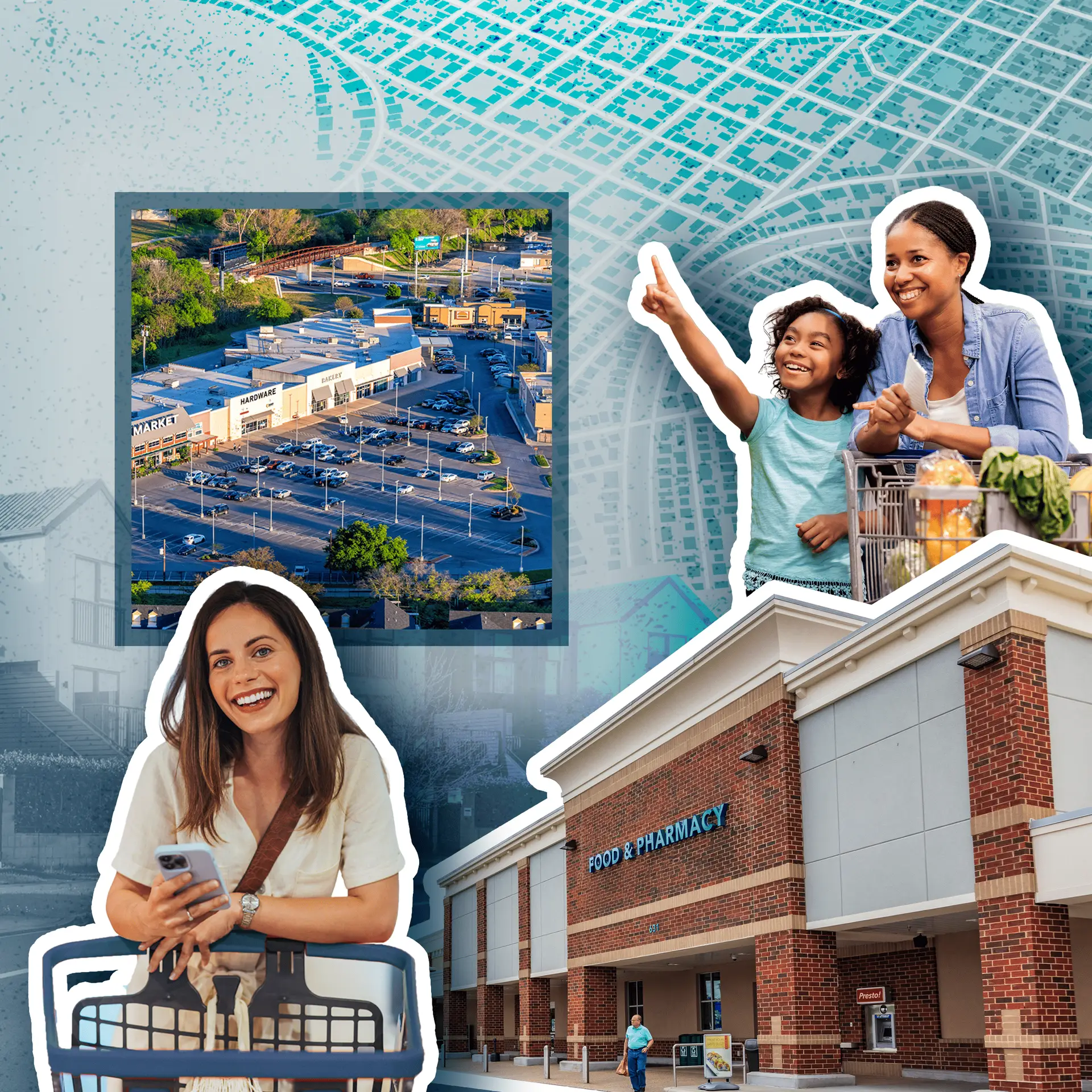
Brick-and-mortar retail continues to prove resilient despite headlines to the contrary. Physical retail has become more targeted, integrating omnichannel capabilities to create a more seamless customer experience. The result is not a disappearing sector, but an increasingly bifurcated one, where necessity-based, well-located neighborhood centers may be better positioned than traditional malls.
Open-air neighborhood and community shopping centers, which typically include grocery stores, convenience retailers, fitness centers, family entertainment venues and healthcare services, accounted for nearly 70% of all physical retail activity in 2025 and so far in 2026, it remains the dominant portion of the U.S. shopping-center market according to CBRE. By meeting everyday consumer needs and generating predictable, consistent traffic, these centers continue to benefit from consistent consumer demand.
As new retail construction remains constrained, demand is increasingly focused on existing centers that offer strong locations, stable traffic and tenant mixes aligned with recurring consumer demand.
The Disconnect Between Market Perception and Reality
Despite persistent narratives around the decline of brick-and-mortar retail, first-half 2026 data points to a sector that remains remarkably resilient. Retail availability held at just 4.9% nationally through the second quarter, according to CBRE, while the market posted four consecutive quarters of positive net absorption. JLL reported 10.2 million square feet of net absorption in Q2 2026 alone, the second-strongest quarter in two years, underscoring sustained demand for physical retail space even amid economic uncertainty. Rather than disappearing, retail demand is increasingly concentrating in necessity-based, convenience-oriented, and open-air formats that align with how consumers live and shop today.
Two factors continue to reinforce this perception. First, the rapid expansion of e-commerce has changed how consumers shop, leading some observers to treat digital and physical retail as competing channels. In practice, the two are increasingly integrated. Stores now serve as fulfillment hubs, pickup locations, showrooms, and experiential spaces, extending their role beyond traditional platforms.
Second, store closures are highly visible and widely reported, while openings, expansions, and successful repositioning events receive far less attention. Visible vacancies along retail corridors further reinforce the perception of a decline.
In-store locations are becoming fully integrated into omnichannel strategies, extending well beyond traditional transaction volume to include logistics, convenience, and customer engagement. At the same time, demand is growing for experience-driven environments that combine dining, entertainment, wellness, and social engagement. These destinations consistently attract foot traffic, particularly in formats that cannot be replicated online.
Malls Don’t Define Retail
Much of the pressures associated with retail over the past decade have been concentrated in enclosed regional malls, particularly those reliant on major department store anchors. That experience has shaped public perception of the broader sector, even though open-air, grocery-anchored and service-oriented centers have followed a different trajectory.
Consumer discovery increasingly begins online, but many retailers continue to use physical locations to support product trial, brand engagement and in-person experiences.
Why Neighborhood Centers Continue to Stand Out
Necessity- and convenience-based retail centers tend to be less exposed to swings in discretionary spending because they are tied to everyday consumer needs and recurring trips. Community shopping centers that benefit from steady day-to-day foot traffic may be better positioned than destination-driven retail formats, which often depend on longer, less frequent trips.
Retailers continue to gravitate toward formats supported by recurring consumer demand, with grocery stores and discount retailers accounting for roughly half of new store openings by square footage in 2025. KBS previously explored the drivers behind this trend in Why Grocery-Anchored and Open-Air Retail Should Remain a Safe Harbor in 2026.
KBS has seen similar dynamics in urban, mixed-use environments where retail benefits from daily activity, walkability, and proximity to employment or transit. At Accenture Tower in Chicago, retail located above the Ogilvie Transportation Center benefits from commuter activity and nearby office and residential density. In Portland, street-level retail at the Meier & Frank building benefits from its central location, walkability and integration with an active urban corridor. While these assets are not traditional grocery-anchored centers, they reflect the same broader principle: retail tied to recurring daily use patterns may be better positioned than formats dependent on occasional destination-driven trips.
Walkable environments also support retail performance by increasing consumer exposure, encouraging more frequent visits and strengthening the connection between retail, residential, office and service use. “The 15-minute Neighborhood,” concept, where everyday needs are located within a short walk or bike ride, reinforces the importance of convenience, access, and local engagement in retail demand.
The retail market has become increasingly bifurcated. Well-located, grocery-anchored neighborhood centers appear better positioned to attract consumer traffic, tenant demand and investment capital, while lower-quality assets may face more persistent structural challenges.
This pattern is not unique to retail. A useful parallel can be drawn to the current office sector, where the decline of lower-quality, Class-C assets often dominates the narrative despite relatively stable or improving fundamentals in higher-quality properties. In both cases, market perception is heavily influenced by visible distress at the lower end of the spectrum, which can obscure underlying resilience and performance.
Limited New Supply Drives Absorption
According to CoStar, the combination of steady leasing demand and limited new supply has strengthened retail fundamentals across many retail segments, contributing to higher absorption and lower vacancy rates.
Due to constrained new supply, much of today’s leasing activity is within existing space. Grocery stores, discount retailers, and sporting goods operators have been among the most active tenants backfilling second-generation space, while adaptive reuse has become an increasingly attractive and sustainable alternative to new construction.
The slowdown in construction should not necessarily be viewed as a sign of weakening fundamentals. Instead, it may reflect a more disciplined phase of the real estate cycle, with capital focused on optimizing existing assets and selectively pursuing development in high-growth markets where demand drivers remain durable.
This shift from supply creation to absorption mirrors similar trends in the workplace sector where repositioning existing assets has become a preferred strategy over large-scale, ground-up development. Across both market types, performance is increasingly driven by effective asset management rather than new supply. Looking ahead, success may depend less on what is newly built, and more on how effectively existing properties are repositioned and managed to meet evolving demand.
Capital Flows and Investment Trends
Retail has largely stood apart from other commercial real estate sectors because it worked through its supply imbalance years ago. Unlike multifamily and industrial markets which continue to absorb significant volumes of recently delivered space, retail entered 2026 after an extended period of constrained development. This disciplined supply environment has helped drive some of the strongest occupancy fundamentals in commercial real estate, while also enhancing the value of existing assets.
As the market evolves, many of the more attractive retail opportunities appear to be concentrated in high-quality neighborhood and grocery-anchored centers. Add to this, adaptive reuse and redevelopment projects, and strategies that improve existing properties through repositioning, land-use optimization and mixed-use integration. With limited new supply and elevated replacement costs, investors are placing greater emphasis on asset quality, competitive positioning, tenant mix and long-term capital requirements. Well-maintained centers with durable demand drivers may be better positioned to attract capital than assets requiring significant reinvestment or facing weaker tenant demand.
Where is In-Store Retail Headed?
Retail’s recovery is not uniform, and the sector remains highly dependent on location, tenant mix, consumer behavior and capital discipline. But the broader shift toward necessity-based, convenience-oriented and well-located retail underscores the continued relevance of physical retail within the consumer ecosystem. In a market where new supply remains constrained, existing centers that serve recurring daily needs may be increasingly important to both tenants and investors.
For KBS, these trends reinforce the importance of disciplined market selection, active asset management and a clear understanding of how retail demand is influenced by surrounding land uses, infrastructure and consumer behavior. As retail continues to evolve, well-located properties with durable demand drivers, diversified tenancy and strong connectivity to daily-use environments may be better positioned to navigate changing market conditions.