Commercial real estate (CRE) places a significant strain on the environment. According to the Environmental Protection Agency, commercial and residential buildings account for about 30% of total United States greenhouse gas emissions.
Advances in CRE design and operations can lead to lower operating costs and potentially strengthen returns. In short, improving green initiatives serves a dual purpose: protecting natural resources and safeguarding property values.
To put it another way, sustainable buildings incorporate strategic initiatives in energy, water,
and waste management that reduce consumption and carbon emissions. Beyond operational improvements, workplaces that support sustainability tend to reduce turnover, enhance the tenant experience, and strengthen the property’s reputation, which in turn, should lead to increased net-operating income (NOI) and asset value.
There are numerous ways to evaluate sustainability practices. One way is through third-party verifications and certifications, which validate quality and build trust with stakeholders. Over time, these certifications have evolved from niche initiatives to measurable pillars for how CRE is built, marketed, and valued. Driven by environmental awareness, developers, investors, and tenants continue to align their goals with green building standards.
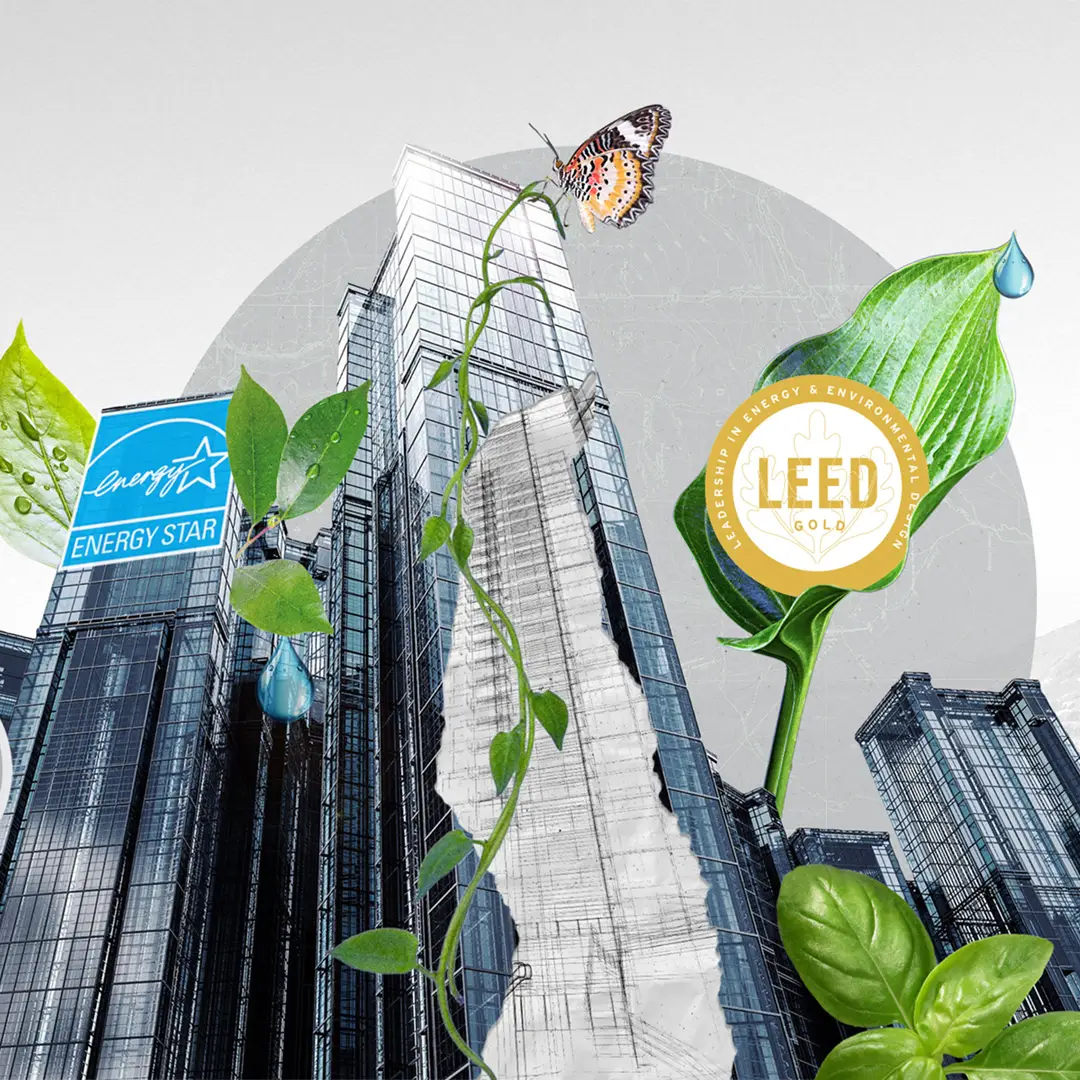
Building certifications like LEED® and ENERGY STAR® have become an expectation in real estate, signaling that a property is built and managed to the highest environmental and wellness standards. These are more than just feel-good labels; they can directly impact office NOI and asset value.
Organizations that offer verifications and certifications must clearly state and evaluate all applicants by the same, exacting standards. Most organizations offer expert assistance with the certification process.
LEED certification, for example, requires investments that lower operating costs, reduce waste, and create healthier indoor environments; all of which should translate into higher rental rates and stronger tenant retention. KBS is continuously searching for responsible and effective ways to add value through climate resilience.
For example, across our portfolio, KBS has implemented WELL Health-Safety Rating™ protocols in 45 properties totaling more than 16 million square feet, alongside numerous LEED-certified assets. These steps not only meet the standards of respected organizations, like the International WELL Building Institute™ (IWBI) and Green Business Certification Inc.™ (GBCI®), but also help strengthen tenant loyalty and attract high-quality tenants willing to pay more for quality.
Ten Almaden, a KBS Class A office tower in San Jose, California, is an excellent example of sustainable features that improve the tenant experience. The property offers amenities such as a modern fitness center, the “Club Ten” tenant lounge, EV charging stations, secure bike storage and a FloWater refill station.
Ten Almaden is LEED Gold certified, WELL Health-Safety Rated, ENERGY STAR certified, 360 certified by the Building Owners and Managers Association (BOMA), a key trade organization for commercial property professionals. The property was also the 2024 Silicon Vally BOMA winner for The Outstanding Building of the Year (TOBY), which recognizes excellence in building operations and management.
In addition, Ten Almaden achieved top marks in tenant satisfaction across the KBS portfolio, as a recipient of the 2024 Kingsley Survey Tenant Satisfaction Excellence Award.
Its layered focus on service, sustainability, and well-being has created an elevated tenant experience and a community where people and businesses thrive. The GRESB Real Estate Assessment has become one of the benchmarks for successful sustainability efforts, and participation in this assessment can support long-term value growth.
According to an academic study published in the Journal of Real Estate Finance and Economics, titled “Sustainability and Private Equity Real Estate Returns,” researchers found that GRESB reporting is becoming a fundamental expectation for the National Council of Real Estate Fiduciaries (NCREIF) and Open-Ended Diversified Core Equity (ODCE) index funds.
Participating funds outperformed non-participating funds, even when controlling for differences in fund size, investment style, and leverage. Over the full 11 years, GRESB participants delivered a buy-and-hold return of 40 percentage-point higher than non-participants, equivalent to around 1.8% a year.
In 2025, KBS Real Estate Investment Trust III (KBS REIT III), part of KBS’ client portfolio of funds and separate accounts, achieved three Green Star designations, for the second year in a row. A three-star rating places KBS REIT III in the top 60% of all 2,223 real estate entities that participated worldwide.
This improvement reflects our commitment to sustainable asset management and demonstrates that we’re not only meeting industry standards but exceeding them. Strong GRESB performance signals that a property stands out among the premier assets in its class.
KBS is committed to environmental stewardship across the organization. In 2022, CEO and Eastern Regional President Marc DeLuca created and maintains the company’s Green Team. Led by ESG Manager, Apaulo Malloy, the team established the company’s ESG program, which monitors climate resilience assessments and energy audits.
Additionally, the Gridium Energy Management System has been implemented to support the ongoing energy reduction goals of KBS. With continuous monitoring and the rollout of strategic energy reduction initiatives, KBS exceeded its first major target — more than doubling its initial goal of a 5% reduction in greenhouse gas (GHG) emissions at the end of 2025.
The real estate industry is at a turning point, where sustainability can be a competitive advantage. Owners are investing in operational improvements like recycling programs and smart building systems, while pursuing LEED, WELL, and GRESB certifications to demonstrate value, attract tenants, and improve profitability.
This article first appeared in the 2026 edition of KBS Premier magazine, which can be found here. To learn more about KBS and the commercial real estate industry, visit KBS.com/Insights.