
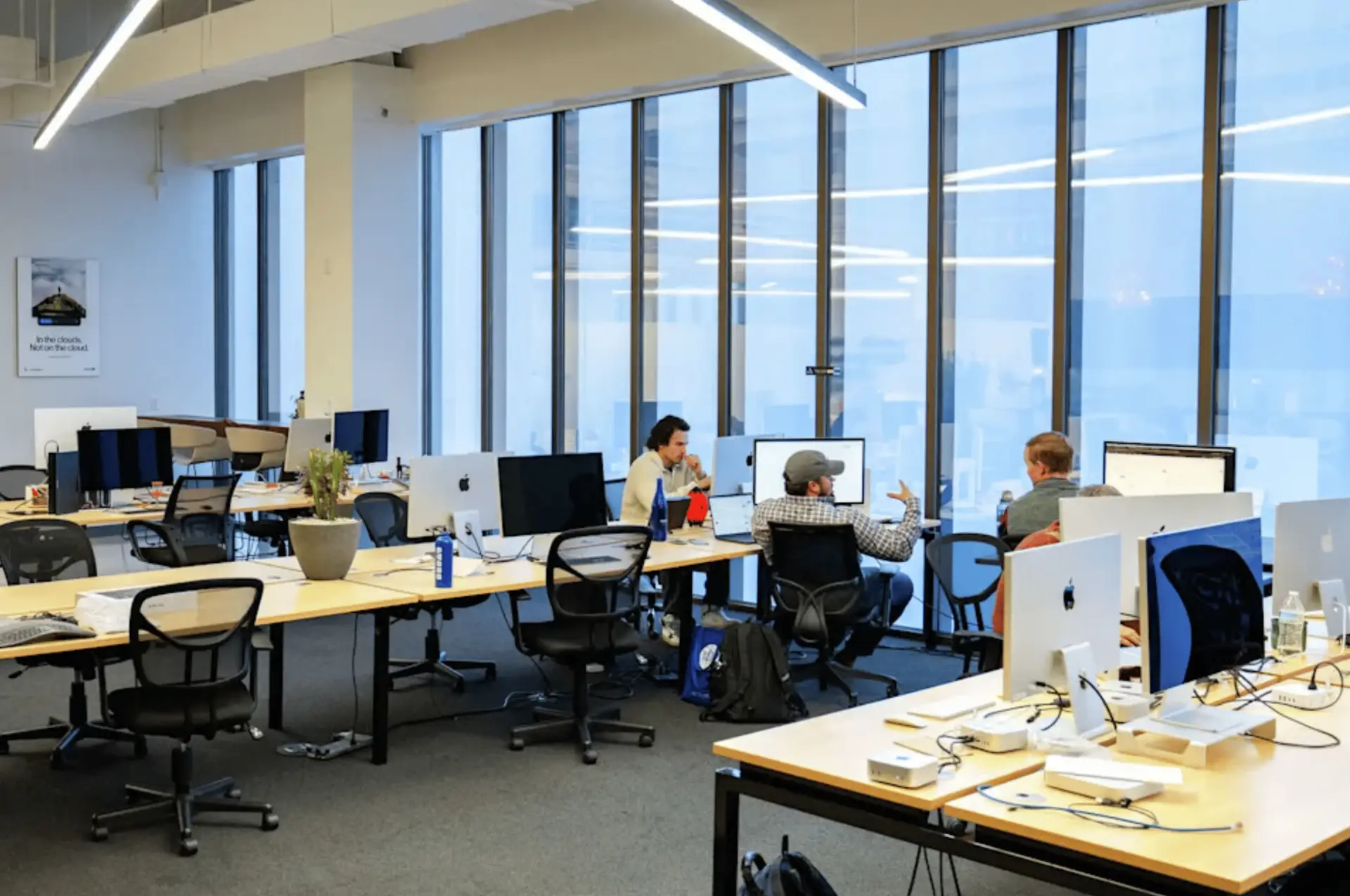
Taking over several floors at 515 Congress Ave., webAI is building a new kind of AI network — one that doesn’t rely on data centers.
Growing up in a blue-collar household in rural Michigan, David Stout never believed Silicon Valley’s vision of artificial intelligence would offer much practical benefit to his parents.
In its early days, AI had few use cases outside the reaches of the corporate world. Today, the rapidly expanding technology is becoming increasingly mainstream. But many of its most common applications still require massive amounts of computing power. Fueled by the rapid growth of the data center industry, AI also consumes significant amounts of energy and water, raising questions about sustainability as adoption accelerates.
In college, driven by a love of computers, Stout threw himself into studying machine learning. Over time, he began thinking about how to make AI both more accessible and more sustainable.
He later met fellow Michiganders and computer engineers Ethan Baird and Tyler Mauer, who shared his vision. In 2019, after experiencing a few startup missteps, the trio decided to try a different approach, founding webAI, an AI company designed to eliminate the need for data centers by tapping the computing power already built into smartphones.
Just a few years later, that startup operates out of a lofty downtown Austin high-rise and carries a $2.5 billion valuation.
“It’s surreal,” webAI CEO Stout said about the investor backing. “It seems like a pipe dream for some Midwestern boys from Michigan to be building an AI company.”
AI without data centers
Unlike other AI companies, webAI aims to bring the technology down to the level of a singular household, business, building or even personal devices. The goal: to run AI more efficiently, tailor it to specific users and avoid overbuilding massive systems.
Instead of relying on a single system, the startup hopes to equip individuals to build their own AI systems, deisgned to run on a much smaller scale. Stout said this approach reduces energy demands, increases privacy and puts the technology directly in users’ hands.
Mauer, webAI’s chief product officer, said each user has an individualized AI system, or chatbot, that can provide more accurate answers and better protect their data.
The company does this by bringing computing power down to the size of a desktop computer, rather than relying on “multibillion-dollar infrastructure that goes away in five years,” Mauer said.
“Everyone’s overbuying hardware, and they don’t know what to do with it,” Mauer said. “How do we put people with the knowledge to actually make it usable? How do we allow people to buy what they need, not overbuying because you’re trying not to miss out on the AI hype.”
Those ideas appear to be gaining traction.
The company has grown to hundreds of employees across three offices — in Michigan, Virginia and at its Austin headquarters.
Apple uses webAI for MacStadium, the company’s enterprise platform, to bring its large language models down to a smaller scale while maintaining similiar power and accuracy. Oura Ring, the health tech company that builds wearable smart rings, integrates webAI as its primary AI infrastructure to ensure privacy. Airline operations platform Springshot relies on webAI to enhance safety checks.
And the company’s latest funding round — which includes investments from Marc Benioff’s TIME Ventures, Atreides Management, Forerunner and OXCART Ventures — values webAI at $2.5 billion.
“I don’t want a future where we’re renting intelligence from someone from Silicon Valley,” Stout, who serves as the company’s CEO, said. “I think that’s a pretty lame outcome. There’s a lot of these big companies that are playing dystopian games, and I don’t like that. It’s really inappropriate. We’re trying to do the opposite, focus on human ingenuity and making humans better, not extracting from them.”
Plans to grow
Although founded in Michigan, the startup has since relocated its headquarters to Austin, taking over the top floor of the 515 Congress Ave. tower and expanding to two additional floors.
“The technology and software, and the people of Austin have this mentality of almost limitless creativity, while also being grounded in the real. And it’s a really beautiful dynamic,” Stout said about moving to Austin. “We want to create a downtown culture as a company. And it’s really sad that the big companies are not here. Let’s invest in the downtown and create a great culture for our team. We want to be a downtown business. Best decision we ever made.”
The company’s name will soon grace the side of the high-rise at the corner of Sixth Street and Congress Avenue, which also houses several other tech companies.
As the company grows, Stout said he sees new employees nearly every week.
The company has been recruiting senior talent from Silicon Valley, the public sector and the business world, including PJ Maykish, who formerly worked in national security and intelligence under President Donald Trump’s first administration and during Biden administration.
In the coming year, Mauer said webAI will soon begin another funding round, expecting to bring in an even higher valuation, and will launch some new products, including its own consumer-facing app.
In the coming year, Mauer said webAI plans to begin another funding round, aiming for a still-higher valuation, and will launch new products, including its own consumer-facing app.
“The goal with that is to release products that are a little bit less enterprise focused, and more we can touch and feel and can experience,” Mauer said. “We think that when you can get the benefits of AI in a way that empowers you and makes you feel more capable as an individual, it’s a very telling experience.
Story first published in Yahoo!Finance